LLMLL: a goto-fail body, rejected before the edit lands
Burc Sahinoglu · 29 October 2026. A self-contained demonstration. The five-post series tells the longer story, up to 163 functions.
LLMLL is a programming language built for AI agents to write. A function starts as a contract, a precondition and a postcondition, with a typed hole where the body goes. An agent checks the hole out, proposes a body, and the compiler hands the body and the contract to an SMT solver. A body the solver cannot prove is rejected before it lands, and the program is left as it was.
This page runs that loop once, on the invariant behind a real bug, and shows every diagnostic it produces.
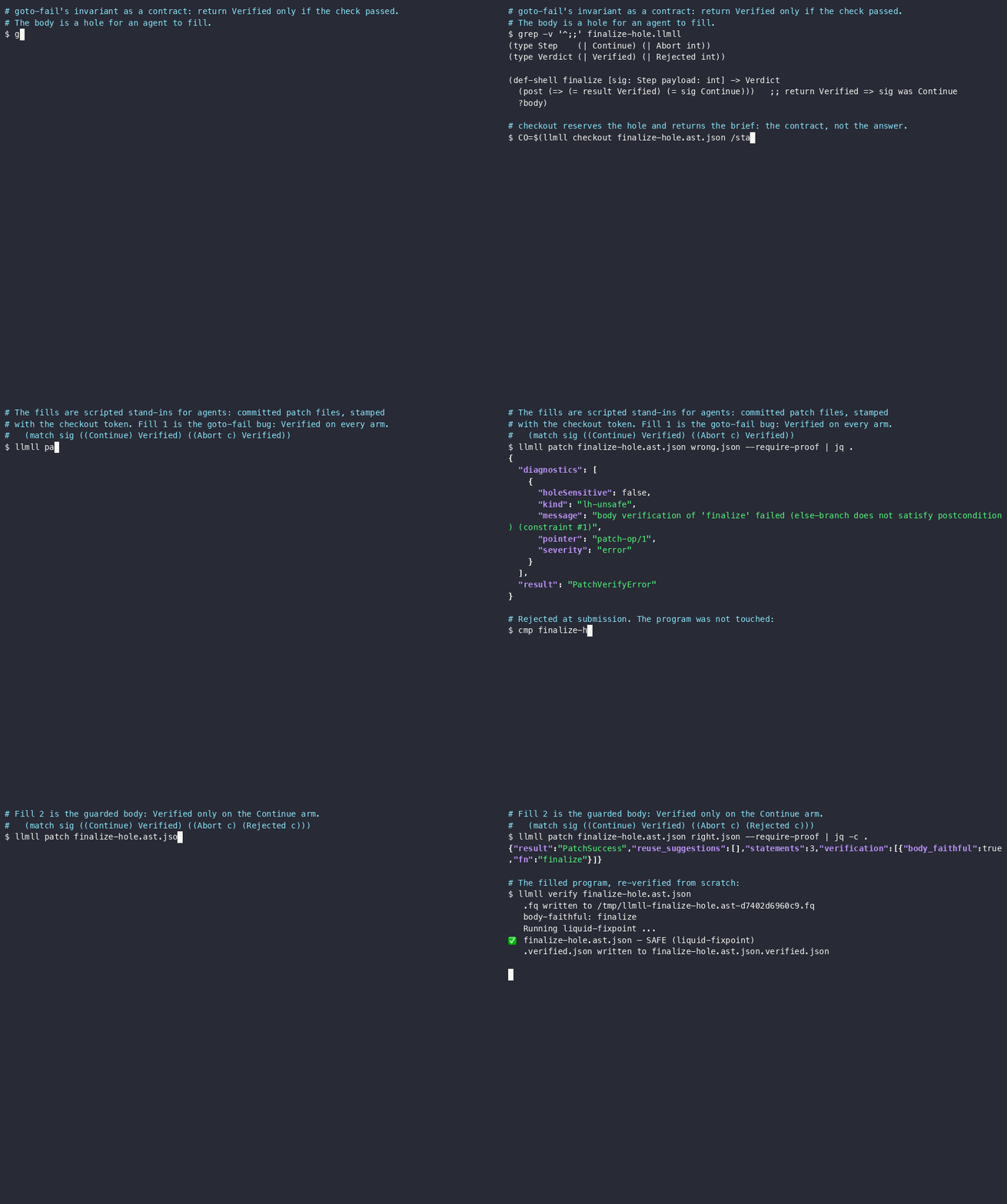
The two fills in the recording are scripted stand-ins for agents: fixed patch files committed to
the repository, so the rejection is reproducible. Script:
examples/gotofail/demo.sh.
The contract
In 2014, Apple’s goto-fail bug (CVE-2014-1266) reported a TLS handshake as successful on a path
where the signature check never ran. The mistake was about whether a check executes. Written as
a contract, the invariant is: return Verified only if the check passed.
(type Step    (| Continue) (| Abort int))
(type Verdict (| Verified) (| Rejected int))

(def-shell finalize [sig: Step payload: int] -> Verdict
  (post (=> (= result Verified) (= sig Continue)))   ;; return Verified => sig was Continue
  ?body)
?body is the hole. An agent asks for it with llmll checkout, which locks the hole and returns
a brief: the postcondition, the return type, the names in scope and a lock token. The brief has
no reference body and no hint.
{
  "postcondition_goal": "(=> (= result Verified) (= sig Continue))",
  "expected_return_type": "Verdict"
}
A wrong fill is rejected
Say the agent makes the goto-fail mistake and returns Verified on every path:
(match sig ((Continue) Verified) ((Abort c) Verified))
It submits the body as a JSON-Patch against the program’s JSON-AST, with --require-proof:
$ llmll patch finalize-hole.ast.json wrong.json --require-proof
{
  "diagnostics": [
    {
      "kind": "lh-unsafe",
      "message": "body verification of 'finalize' failed (else-branch does not satisfy postcondition) (constraint #1)",
      "pointer": "patch-op/1",
      "severity": "error"
    }
  ],
  "result": "PatchVerifyError"
}
The patch is refused and the file is byte-for-byte unchanged. The diagnostic names the branch
that fails: the else branch, the one that returns Verified when sig is Abort. That is
the input the real bug shipped on.
The guarded fill is accepted
(match sig ((Continue) Verified) ((Abort c) (Rejected c)))
$ llmll patch finalize-hole.ast.json right.json --require-proof
{"result":"PatchSuccess","reuse_suggestions":[],"statements":3,"verification":[{"body_faithful":true,"fn":"finalize"}]}

$ llmll verify finalize-hole.ast.json
   body-faithful: finalize
   Running liquid-fixpoint ...
✅ finalize-hole.ast.json — SAFE (liquid-fixpoint)
body_faithful means the solver proved the postcondition from the body itself. It did not
assume the contract.
What the contract leaves open
This contract is a safety property. It forbids returning Verified when the check failed,
and it does not require returning Verified when the check passed, so a body that always
returns (Rejected 0) also verifies. Ruling that out takes a stronger contract, with <=>
in place of =>. Post 2
runs both versions.
Which pass rejects it
The rejection comes from the verifier, not from the type checker. llmll build checks types and
emits Haskell, and it compiles the wrong body without complaint. The proof runs in llmll
verify, and in llmll patch, which re-verifies the patched function before writing anything.
With --require-proof, a patch is also refused when its function passes only because the
solver fell back to assuming the postcondition.
What this shows, and what it does not
Why a language for this, and not a verifier behind an agent tool. The verifier is not the new part: Dafny, Liquid Haskell or F* would reject the same body, and LLMLL’s proofs run on liquid-fixpoint and Z3. What LLMLL adds is the loop around the proof, built into the toolchain:
- The unit of work is a hole with a contract.
checkouthands an agent that hole’s contract and the names in scope as JSON, and locks it. patchapplies the agent’s body and verifies it before writing, so a rejected edit leaves the program byte-for-byte unchanged, and the lock stays with the agent so it can retry.- A rejection is JSON with a kind, a message and a pointer into the patch, so a repair loop can act on it without parsing compiler text.
refinelets an agent split a hole into helper holes with contracts of their own, while the parent stays held to its original contract (Post 4).
None of this needs a stronger solver. It lets you hand one function at a time to an agent and take back only bodies that verify, with the rest of the program untouched. How contracts compose across calls is Post 3.
Scope.
- As of
llmll0.33, the solver covers linear integer arithmetic, booleans, non-recursive sums, pairs, fixed-size bytes, maps and string literals, each with restrictions listed in the language reference. Outside that fragment a postcondition is assumed,verifynames the function, and--require-proofrefuses the fill. - A proof shows that the body meets the contract, for every input that satisfies the precondition. It does not show that the contract is right. Whether the contract says the right thing is a human reviewer’s job.
- The example is one function. The series scales it up to an arithmetic model of the TLS record layer’s control flow and bounds: 163 agent-written functions, verified as one program (Post 5). That model computes no hash, MAC or cipher, and it is not a verified TLS implementation.
- A verdict trusts its tools: LLMLL’s translation to solver constraints, liquid-fixpoint, Z3, the Haskell code generator and GHC.
Run it
With Docker and nothing else, see the rejection:
docker run --rm ghcr.io/machunter/llmll verify /opt/llmll/examples/gotofail/finalize-bad.llmll
It prints error: body verification of 'finalize' failed (else-branch does not satisfy
postcondition). Swap finalize-bad for finalize to see the guarded body verify.
To run the whole checkout-and-patch loop from the recording, build llmll from
the repository and run
bash examples/gotofail/demo.sh. It needs liquid-fixpoint, z3 and jq on your PATH.
Try to break it
Two kinds of report are useful, and they show different things:
- A body that breaks its contract and still verifies. That is a verifier bug, and the most serious kind of report this project can get.
- A body that meets its contract and is still wrong, like the always-reject body above. That shows a contract that says too little.
Either way, open an issue.
Read on
The series goes from this one function to 163: